Beyond Chatbots: How Jev and System-1 Models Eliminate 90% of Agent Latency
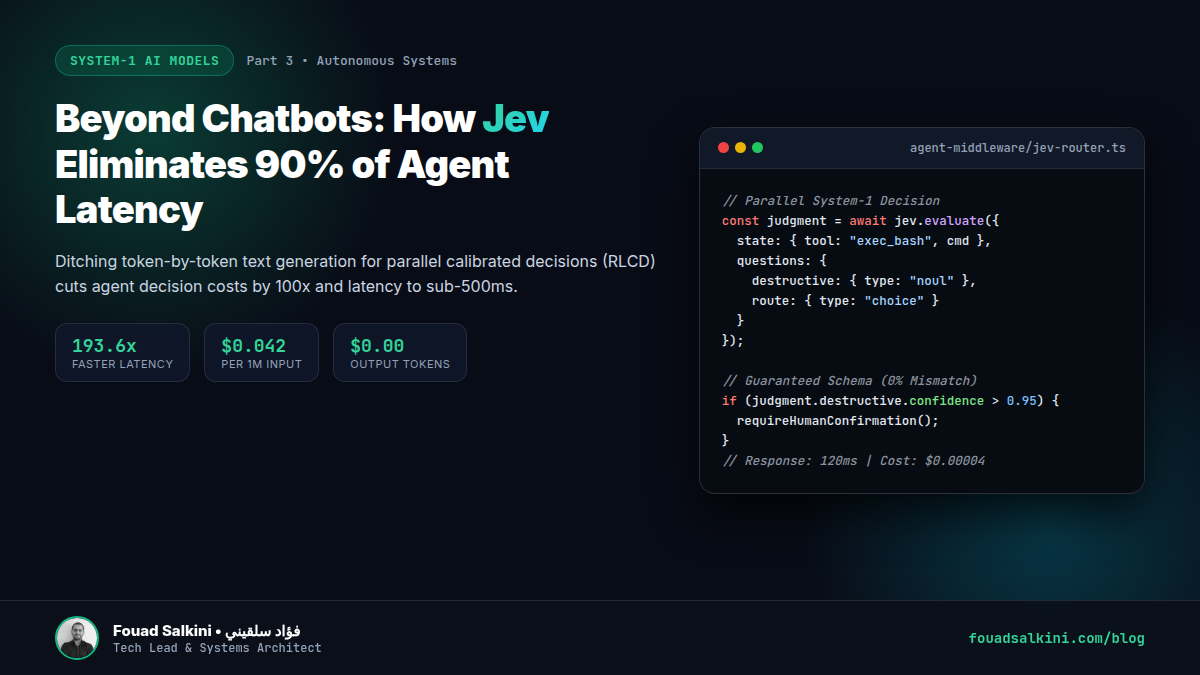
Architectural analysis of TypeSafe AI's Jev: why ditching text generation for parallel calibrated decisions (RLCD) cuts agent decision costs by 100x and latency to sub-500ms.
When building autonomous coding agents and high-throughput production pipelines, the dirty secret of modern AI engineering is that most LLM calls are massive architectural waste.
When an agent needs to determine whether a bash command is safe to run, route a database query to the correct shard, or classify whether an automated linter failure warrants a code rollback, it doesn’t need a 70-billion-parameter model composing polite, conversational prose token by token.
What it needs is a deterministic, calibrated decision—and it needs it in milliseconds.
Enter Jev, the first public foundation model from Diogo Almeida’s TypeSafe AI, marking a pivotal bifurcation in machine learning: the emergence of pure System-1 foundation models.
1. Autoregressive Overhead: The System-2 Bottleneck
Most developers still operate under the mental model that frontier intelligence requires autoregressive text prediction. But for software-to-software automation, text generation is an expensive liability:
- Latency Penalty: Generating 150 tokens of rationalization takes between 3 to 10 seconds on frontier models. In a 30-step autonomous coding loop, conversational overhead alone adds 3 to 5 minutes of dead waiting time.
- Schema Brittle: Autoregressive models can still occasionally output invalid enum values or hallucinate a non-existent tool parameter under distribution shifts.
- Asymmetric Billing: Charging high output token rates for questions whose only utility is a Boolean (
true/false) or an index selection.
Traditional Agent Loop (Autoregressive):
[State] ──> [LLM Token-by-Token Reasoning] ──> [150 Tokens of Text] ──> [Regex / JSON Parse] ──> Action (4-8s)

System-1 Agent Loop (Jev):
[State + Typed Questions] ──> [Parallel RLCD Sampler] ──> [Typed Calibrated Scores] ──> Instant Action (120ms)
2. Technical Primitives: The Machine-to-Machine Contract
Jev strips away strings completely. It receives a structured state payload (such as a serialized AST, JSON metrics, or execution logs) and evaluates three native primitives in a single parallel pass:
- Choice: Evaluates categorical selection across up to 255 predefined options.
- Score: Returns calibrated continuous scores on defined numeric ranges.
- Noul: TypeSafe’s primitive for calibrated Bayesian confidence probabilities (0.0 to 1.0).
Because Jev uses Reinforcement Learning for Calibrated Decisions (RLCD) and parallel sampling, question evaluation does not scale sequentially. Asking 1 assertion or 15 assertions on the same state payload occurs in virtually the identical ~100–300ms window.
Production Example: Agent Execution Guardrail
Here is how we integrate Jev as real-time middleware to audit agent tool execution before hitting the operating system:
import { TypeSafeClient } from "@typesafe/sdk";

const jev = new TypeSafeClient({ apiKey: process.env.TYPESAFE_API_KEY });

interface CommandAuditResult {
  isDestructive: boolean;
  confidence: number;
  riskCategory: "safe" | "network_sensitive" | "destructive";
}

export async function auditAgentCommand(
  command: string,
  cwd: string
): Promise<CommandAuditResult> {
  const judgment = await jev.evaluate({
    state: { command, cwd, userEnv: "production" },
    questions: {
      destructive: { type: "noul", prompt: "Will this command alter persistent filesystem state or drop tables?" },
      risk: {
        type: "choice",
        options: ["safe", "network_sensitive", "destructive"],
        prompt: "Categorize the execution blast radius."
      }
    }
  });

  return {
    isDestructive: judgment.destructive.value && judgment.destructive.confidence > 0.85,
    confidence: judgment.destructive.confidence,
    riskCategory: judgment.risk.selected
  };
}
3. The Economics of the Jevons Paradox
The model’s name is an explicit homage to 19th-century economist William Stanley Jevons, who observed that improving steam-engine coal efficiency did not decrease coal consumption—it made coal economical enough to power the entire Industrial Revolution.
At $0.042 per million input tokens ($42 per billion) and $0.00 output costs, Jev fundamentally alters software architecture:
- 10,000 daily decision loops that would cost over $1,000/month on frontier chat models run for under $4/month on Jev.
- Latency drops from seconds to human-imperceptible milliseconds, unlocking real-time reactive routing, sub-second continuous code testing, and high-frequency IoT telemetry arbitration.
The Verdict
Chatbots were the consumer catalyst for the AI wave. But for systems architects building the autonomous infrastructure of the next decade, text generation is an unnecessary tax on machine-to-machine coordination.
By formalizing System-1 parallel decisions, Jev proves that true engineering efficiency isn’t about writing bigger prompts—it’s about building leaner, typed, and calibrated primitives.

Written by Fouad Salkini (فؤاد سلقيني)
General Manager & Tech Lead at Tripnologies and Sync Studios. Systems Architect focusing on AI coding agents, DevOps, and quantitative systems.