DeepSeek Super-agent: GitHub Requests, Parallel Workers and the Permission Boundary
DeepSeek Super-agent's public prototype and original team design explained: GitHub coordination, context recall, asynchronous workers, human oversight and a simulated latency-versus-cache-read trade-off. What is shipped, what is proposed, and the permission boundary.
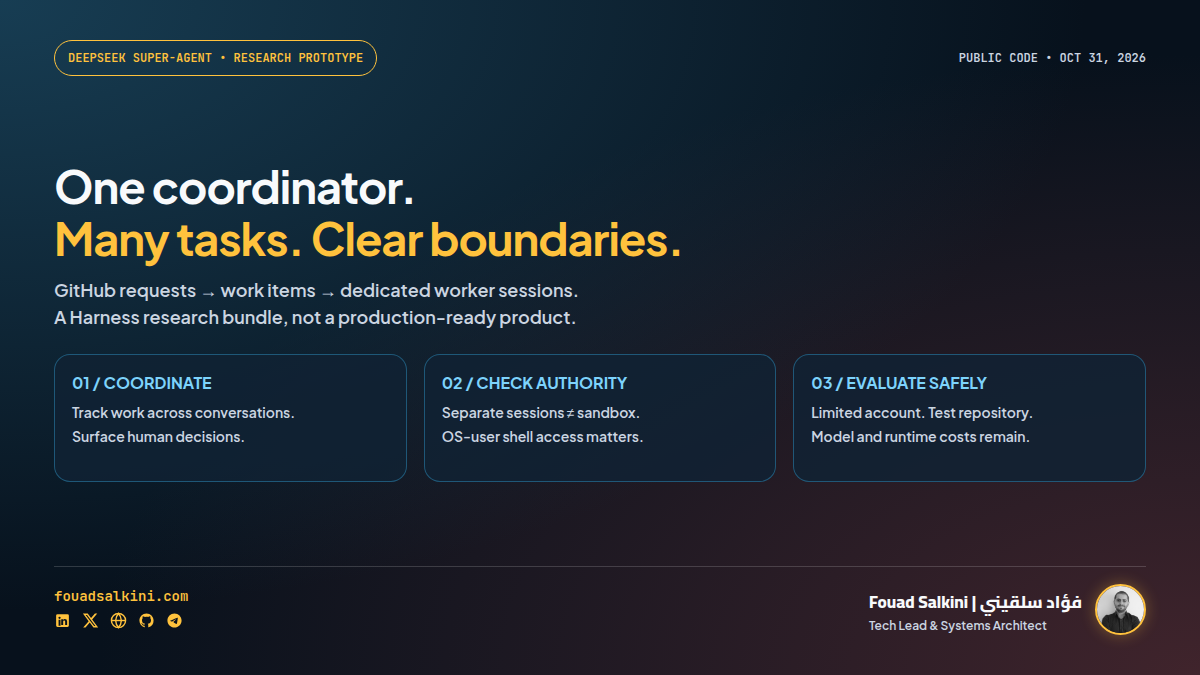
The interesting part of DeepSeek’s Super-agent is not another model. It is a way to keep repository work moving across conversations, separate worker sessions and human decisions.
The DeepSeek Harness team published dsh-superagent-prototype, an MIT-licensed research implementation for one GitHub repository. It listens to GitHub and, optionally, Feishu; turns allowed requests into work items; and returns results to the original conversation, for example as a pull request. [1][9]
The public repository’s initial commit is dated October 31, 2026; the team published its architectural article on November 1, 2026, alongside the November 1 coverage. The README explicitly says “Research prototype for reference only, not an official DeepSeek product.” It warns that the code is not production-ready and that parts of the broader design are not implemented here. Published in DeepSeek’s organization does not mean ready to connect to your production accounts. [1][2][11][13]
Update — November 3, 2026: this article now includes the team-published English design article, its architectural ideas and preliminary simulation results. The Chinese WeChat route was inaccessible during the initial review; the team’s English version is readable and labels itself a machine translation. The team explicitly says it discusses architectural ideas, not an introduction to existing Harness features. [13]
I reviewed the prototype at 8c32a9dc5d72c033816c6a8110b37f40cf94fba4, including its documentation and selected configuration/source files, and the team’s design article. I did not install it, connect accounts, run a live agent or reproduce a benchmark.
1. What it adds: a coordinator above individual coding sessions
A conventional chat session is not a complete record of a team’s ongoing work. A request may arrive in an issue, continue in a pull-request discussion and require a person’s answer after a worker has stopped.
This prototype makes the work item—called a Ticket—the useful organizing unit:
GitHub / optional Feishu event
  → Check who is allowed and whether work is authorized
  → Route to a new or existing Ticket
  → Run its worker in a dedicated session and directory
  → Handle follow-ups, questions and review
  → Return the result to the original conversation
A main session coordinates routing, while individual Tickets have executor sessions. Subscribed threads feed follow-up context to the relevant work. The web panel prioritizes Tickets that need a person’s answer or review, and shows execution and system history. [3][4][6]
The practical benefit is less manual coordination: the operator should not have to repeatedly paste a discussion into a new session, remember which worker owns it, and relay every question back.
That is an architectural objective—not a measured productivity gain from my review. It is also not a new set of model weights: the prototype uses DeepSeek Harness and a configured model provider. [5]
2. “Proactive” does not mean every chat message becomes a command
The authorization documentation separates explicit requests from inferred opportunities. Allowed people can address the agent; other candidate work must pass policy and rule evaluation. It documents host-enforced allowed lists, rules and authorization records called Mandates. [3]
For inferred work, the default mode is observe: it records what the system would accept rather than starting that work. Moving to auto enables acceptance when the relevant assessment and rules permit it. [3]
A subtle but important limit: explicit requests work in every mode. observe is not a global read-only switch. Do not leave an agent with broad credentials and assume the default means nothing can execute. [3]
Likewise, messages delivered as thread context do not automatically gain new authority. That design distinction is valuable, but it is not proof that the whole system is immune to prompt injection or model mistakes. [3]
3. The most important warning: separate sessions are not a sandbox
The deployment guide states that both router and worker presets run with danger-full-access as the operator’s OS user. Workers can run commands without approval, execute programs by path and read the operator’s home directory. Account wrappers choose credentials; they do not isolate the process. [4][5]
A different working directory—or a Git worktree—helps organize concurrent work. It does not prevent a process from reading unrelated files or using privileges available to that account.
Before a trial, I would require:
- A dedicated OS account or a deliberately isolated environment containing only the credentials it needs.
- A disposable repository first, not a production deployment checkout.
- Restricted GitHub access and no unrelated SSH, cloud or database credentials in the environment.
- Repository-enforced branch protection, required checks and appropriate human review.
- Explicit concurrency, time and spending limits, plus a way to pause or stop work.
These are my recommended deployment controls, not claims that the prototype automatically supplies a complete security boundary.
Review instructions are not the same as repository enforcement
The default delivery prompt says a person merges every PR when no merge CLI is configured. It also describes conditional auto-merge when a separate merge CLI is configured and the required conditions hold. Therefore, “a human always merges” is not an unconditional property of the system. [7]
The project distinguishes editable model instructions from checks enforced by the host. Keep that distinction when evaluating safety: a prompt telling an agent to request review is not equivalent to a GitHub rule that prevents an unauthorized merge. [12]
4. What you need to run it
The reviewed package identifies itself as 0.1.0, with a compatible DeepSeek Harness range of ^0.2.1-alpha.2. The deployment/setup documentation lists Node.js, pnpm, git, Python, tmux, GitHub CLI and a configured model provider. Its Node engine expression is ^22.19.0 || >=24.0.0. [5][8]
The operating model is more involved than installing a chatbot extension:
- A dedicated Harness profile: the guide warns that the plugin changes process-wide PATH and git settings, so it should be separate from your personal working profile.
- One repository on github.com: GitHub Enterprise Server is not supported in the reviewed guide.
- An agent GitHub user account: the documented flow relies on its notifications and repository write access; it is not a GitHub App setup.
- A model provider: the profile’s default model is used unless evaluation or execution settings select another.
- Optional Feishu/Lark integration: separate bot configuration and permissions are required. [5]
The official DeepSeek Harness site describes the underlying platform as a public preview. Super-agent is a bundle on top of that platform, not an interchangeable name for Harness itself. Our earlier ZCode versus DeepSeek Harness guide covers the platform layer; this release concerns repository-level coordination. [10]
I treated SETUP.md as documentation to inspect, not as instructions authorizing changes to this machine. This article is not an installation or an account-connection test.
5. Open source does not mean free operation—or proven superiority
The prototype’s code is MIT-licensed, with the accompanying notice requirements. That does not make model inference, hosting, monitoring or human review free, nor does it replace the terms of its dependencies and connected services. [9]
Parallel workers can reduce some waiting, but may also duplicate context and increase model usage. Measure the full workflow: correct patches, tests on the current revision, retries, review effort, elapsed time and total cost.
6. What the original design adds beyond parallel workers
The broader design is worth separating from the installation checklist. The following are the team’s architectural ideas and internal-system descriptions, not a checklist of features verified in the public prototype. Its README explicitly warns against that equivalence. [1][13]
- Router and Workers: the Router coordinates rather than doing each task itself. Workers carry out individual work, so one long job need not block unrelated requests. Pass-through delivers events directly to subscribed workers without requiring a fresh Router model call for every follow-up. This is a routing optimization, not permission to bypass authorization. [13]
- Context as a cache: Inline & Spill puts likely-needed details into the current context and stores less immediate or oversized material outside it, with references for retrieval. Chain of Recall links events, threads and sessions by IDs so the model can follow those references. This is not a promise of unlimited memory or perfect recall. [13]
- Non-blocking interaction: an asynchronous ReAct loop starts long tools in the background, receives completion as an event and can respond to new input after the current inference step, rather than waiting for every tool to finish. The article says Harness already implements this mechanism, but it was not enabled by default at publication. [13]
- Separate compute, state and execution environments: the design decouples the model loop from where state is stored and tools run, potentially connecting different devices or environments. That is a deployment architecture—not automatic sandboxing. [13]
- An external Watchdog: a separate control loop checks whether workers are making substantive progress, not just whether their processes are alive. This is intended to identify loops, drift and operational failures. It does not establish guaranteed recovery or safe self-modification. [13]
The most reusable idea is to treat human attention and the model’s context as finite resources. Routing, retrieval and escalation should be designed explicitly rather than left to a single ever-growing conversation.
7. What the preliminary experiment actually measured
The team’s experiment used approximately 300 messages per run, including about 20 work requests, and ran each design five times. Coding work was simulated by a tool that consumed time. It measured scheduling and coordination—not whether an agent wrote a correct patch. Message intervals and work durations were scaled to one-quarter of their original values; model-call time was not scaled. The reported minutes therefore describe this experimental setup, not production turnaround predictions. [13]
The author-reported end-to-end results were:
- Super-agent: p50 12.4 minutes, p95 15.7 minutes; 23.2M cache-read tokens per run across all sessions.
- Single session with a subagent tool, neutral prompt: p50 20.4 minutes, p95 29.5 minutes; 6.1M cache-read tokens.
- Single session with a subagent tool, delegation-first prompt: p50 13.8 minutes, p95 29.0 minutes; 10.8M cache-read tokens.
- Super-agent without Pass-through: p50 12.6 minutes, p95 15.5 minutes; 31.8M cache-read tokens. [13]
For the neutral-prompt baseline, the team says the model did not delegate in any of the five runs; with the delegation-first prompt, it delegated in four. This helps explain the result, but also limits what it demonstrates: the comparison depends on this workload, prompts and model behavior. [13]
The trade-off is explicit: Super-agent achieved lower tail latency than those single-session baselines while reading more cached context. Pass-through reduced cache-read overhead relative to the version without it; it did not make this system consume less cached context than either single-session baseline. These are cache-read tokens only—not total tokens, billed dollars or a universal cost multiplier. [13]
I have not reproduced those experiments. They do not establish better real coding quality, fewer defects, lower total cost, or a win over Claude Code or Codex. Those questions need representative repositories, actual patches, current-revision tests and matched budgets.
The original article reinforces the security warning
In Section 8.4, the team treats security and privacy as unresolved problems. It warns that compromise or prompt injection in a cloud-hosted agent loop could put connected endpoints at risk, and that credentials entering model context can leak even without a server compromise. Its proposed architecture therefore needs a way to use credentials without exposing them to the model. This is an open requirement, not a verified protection delivered by the prototype. [13]
My assessment
Worth studying: persistent work items, routing across conversations, separate worker sessions, and a panel focused on decisions that need a person.
Not ready for blind adoption: research status, setup complexity, unapproved shell execution and the gap between organizational separation and actual security isolation.
For a team already comfortable operating coding agents, I would evaluate it on a low-risk repository with narrowly scoped accounts. For someone seeking a ready-made, hosted, hands-off assistant, this release should not be presented as that product.
The advance to watch is how agents coordinate and ask for human attention—not permission to remove every boundary around them.
Sources
[1] https://github.com/deepseek-ai/dsh-superagent-prototype/blob/8c32a9dc5d72c033816c6a8110b37f40cf94fba4/README.md — DeepSeek Harness team: prototype status and actual scope [2] https://api.github.com/repos/deepseek-ai/dsh-superagent-prototype/commits/8c32a9dc5d72c033816c6a8110b37f40cf94fba4 — Original public commit: October 31, 2026 [3] https://github.com/deepseek-ai/dsh-superagent-prototype/blob/8c32a9dc5d72c033816c6a8110b37f40cf94fba4/docs/002-authorization.md — Authorization, observe mode and explicit requests [4] https://github.com/deepseek-ai/dsh-superagent-prototype/blob/8c32a9dc5d72c033816c6a8110b37f40cf94fba4/docs/003-execution.md — Per-ticket workers, runtime and recovery [5] https://github.com/deepseek-ai/dsh-superagent-prototype/blob/8c32a9dc5d72c033816c6a8110b37f40cf94fba4/docs/006-deployment.md — Deployment prerequisites, accounts and isolation warning [6] https://github.com/deepseek-ai/dsh-superagent-prototype/blob/8c32a9dc5d72c033816c6a8110b37f40cf94fba4/docs/005-panel.md — Supervision panel and human intervention [7] https://github.com/deepseek-ai/dsh-superagent-prototype/blob/8c32a9dc5d72c033816c6a8110b37f40cf94fba4/prompts/team/delivery.md — Default delivery prompts: review and merge conditions [8] https://github.com/deepseek-ai/dsh-superagent-prototype/blob/8c32a9dc5d72c033816c6a8110b37f40cf94fba4/package.json — Package metadata: 0.1.0 and DeepSeek Harness compatibility [9] https://github.com/deepseek-ai/dsh-superagent-prototype/blob/8c32a9dc5d72c033816c6a8110b37f40cf94fba4/LICENSE — MIT license applies to prototype code [10] https://www.deepseek.com/en/harness — Official DeepSeek Harness public-preview platform [11] https://www.marktechpost.com/2026/11/01/deepseek-dsh-superagent-router-worker-coding-agent — November 1 secondary coverage, not code release chronology [12] https://github.com/deepseek-ai/dsh-superagent-prototype/blob/8c32a9dc5d72c033816c6a8110b37f40cf94fba4/docs/004-prompts.md — Host-enforced controls versus editable prompt instructions [13] https://x.com/deepseekharness/status/2116857257245987236?a=4880YyAVbYW05tTqCjs&s=46 — DeepSeek Harness team: original architecture article, November 1; English machine translation

Written by Fouad Salkini (فؤاد سلقيني)
General Manager & Tech Lead at Tripnologies and Sync Studios. Systems Architect focusing on AI coding agents, DevOps, and quantitative systems.