Inside Hermes Agent: The Autonomous AI Operating System (and What It Can Actually Do)
A deep dive into Nous Research's Hermes Agent: how self-improving procedural skills, persistent cross-session memory, multi-channel gateways, and autonomous terminal execution redefine AI in production.
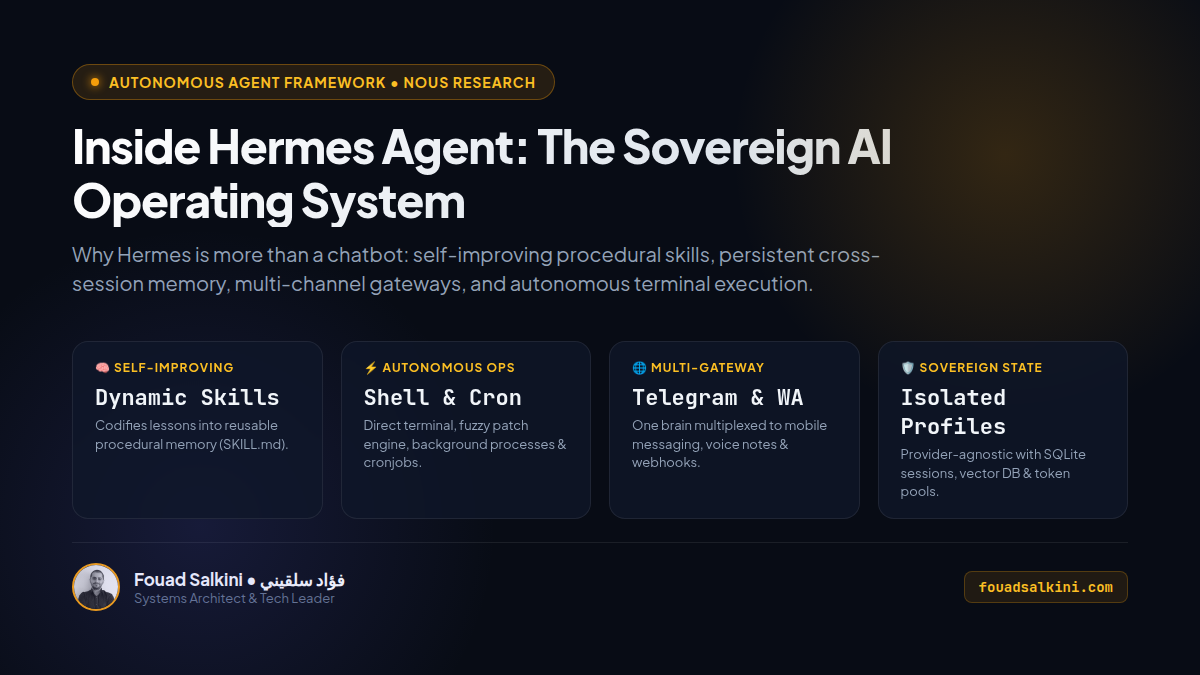
Most people interact with AI through a web chat window: they ask a question, receive a wall of text, copy-paste snippets into their terminal or editor, and manually fix the inevitable errors.
When things get slightly more advanced, developers move to coding CLIs (like Claude Code or OpenAI Codex) to inspect files and run tests. But even those remain bounded to single CLI sessions.
Hermes Agent (developed by Nous Research) belongs to a fundamentally different category: it is an autonomous, sovereign operating system for AI agents.
Instead of being an isolated script or a passive chatbot, Hermes is an persistent agent runtime that lives across your terminal, native desktop, IDEs, and messaging gateways (Telegram, WhatsApp, Slack, Discord). It executes real code, operates servers, schedules its own cron jobs, delegates parallel workstreams to subagent swarms, and—most importantly—learns from its own mistakes by writing its own persistent skills.
Here is an architectural breakdown of what Hermes Agent is, how its engine works under the hood, and what it actually accomplishes in 24/7 production environments.
1. The Core Architecture: An Agent with Real Operating Power
At its foundation, Hermes Agent bridges the gap between frontier LLMs and real-world system execution. While standard frameworks force agents into brittle hardcoded DAGs (like LangGraph or CrewAI), Hermes treats the host environment as a first-class citizen:
┌─────────────────────────────────────────────────────────────────────────┐
│                        HERMES AGENT RUNTIME                             │
├──────────────────┬──────────────────┬─────────────────┬─────────────────┤
│  SURFACES        │  PERSISTENCE     │  EXECUTION      │  ORCHESTRATION  │
├──────────────────┼──────────────────┼─────────────────┼─────────────────┤
│ • Telegram & WA  │ • Skills Engine  │ • Linux Shell   │ • delegate_task │
│ • Discord/Slack  │ • Dual Memory    │ • AST Patcher   │ • Cron Daemon   │
│ • Electron App   │ • SQLite Sessions│ • Python Kernel │ • Model Pool    │
│ • Ink TUI & ACP  │ • Vector DB      │ • Headless Web  │ • Auth Rotation │
└──────────────────┴──────────────────┴─────────────────┴─────────────────┘- Provider-Agnostic Model Engine: Hermes is not locked to one vendor. You can run it on Claude 3.7 Sonnet, OpenAI o3/GPT-4o, Google Gemini, DeepSeek, or completely offline on local Apple Silicon / vLLM clusters. It supports automatic credential pool rotation and intelligent fallback.
- Deterministic SQLite State (
state.db): Every session, turn, token count, tool invocation, and error is indexed with full-text search (FTS5). If a server restarts, the agent resumes without amnesia. - Isolated Profiles (
~/.hermes/profiles/<name>): You can run multiple distinct agent identities on the same server—each with its own configuration, isolated memory, distinct skills, and independent messaging webhooks.
2. The 5 Superpowers That Make Hermes Different
1. Self-Improving Procedural Memory (Skills)
Standard agents repeat their mistakes in every new session. If an agent encounters a quirky API, a tricky authentication handshake, or a unique deployment bug, that knowledge vanishes the moment the conversation ends.
Hermes solves this through Procedural Skills (SKILL.md):
- When Hermes works through a difficult workflow or masters a specific domain, it codifies the procedure into a structured skill.
- These skills are stored in its profile workspace with exact YAML frontmatter, execution checklists, and failure modes.
- In future sessions, whenever a relevant task arises, Hermes dynamically loads the skill, executing with senior-engineer precision without re-inventing the wheel.
2. Dual-Layer Persistent Memory
Hermes maintains two distinct memory tiers:
USER.md(Profile Memory): Who the user is, their architectural preferences, engineering conventions, active server IP addresses, and operational standards.MEMORY.md(Operational Memory): Durable system facts, environment configurations, and production constraints. Both layers are managed atomically with strict character budgets, ensuring context windows are never polluted with ephemeral noise.
3. Direct System & Code Execution
Hermes is equipped with native, production-grade tools:
- Terminal & Shell: Runs foreground and tracked background processes (
nohup, daemon services, build pipelines) with real-time process monitoring. - Fuzzy AST Patcher: Rather than overwriting whole files or relying on fragile regex line edits, Hermes uses a 9-strategy fuzzy matching patch engine that accurately applies surgical diffs even if surrounding whitespace or formatting shifts.
- Headless Chromium & Vision: Renders web pages, captures screenshots, inspects visual layouts, and automates browser interactions with stealth-layer protection.
4. Multi-Gateway Sovereignty (Telegram, WhatsApp & Beyond)
You don’t need to sit at your laptop to collaborate with Hermes. Through its integrated messaging gateway, the exact same agent brain connects directly to:
- Telegram: Bi-directional chat, photo/video rendering, audio voice bubbles via native TTS pipelines, and direct channel broadcasting.
- WhatsApp & Slack: Secure mobile commanding with verify-first execution policies.
- Desktop & IDE: Native Electron GUI, interactive Ink TUI, and ACP servers for VS Code and Zed.
5. Subagent Swarms (delegate_task)
For heavy, multi-step engineering missions, a single linear conversation window quickly hits context limits. Hermes includes a native delegation engine:
- It can spawn parallel, isolated subagents in the background.
- Each subagent receives an isolated terminal environment, a distinct toolset, and a specific subtask.
- Hermes monitors their execution, synthesizes their verifiable artifacts, and integrates the results into the primary workflow.
3. Real-World Production Examples: What Hermes Does Every Day
To understand the difference between theoretical AI and production reality, here is what our sovereign Hermes instance actively manages:
- Automated Full-Stack Publishing: When researching a topic, Hermes browses technical papers, downloads source media, extracts video transcripts via Whisper, renders 1200x675 OpenGraph cover cards using headless Chromium, authors comprehensive MDX articles, builds the Astro SSR application, commits and pushes to Git, deploys to a remote Hetzner VPS via PM2, updates the dynamic sitemap, and broadcasts an Arabic executive briefing to our official Telegram channel—all autonomously in minutes.
- Algorithmic Trading Audits: Inspects Laravel financial bot logs, monitors WebSocket connections, checks database schema migrations, and audits risk management parameters across live crypto exchange endpoints.
- DevOps & Linux Server Administration: Manages Apache reverse proxies, handles SSL certificates, diagnoses systemd daemon failures, and monitors container health across Docker clusters.
- Multi-Source OSINT Intelligence: Runs scheduled cron jobs scouting ArXiv papers, GitHub trending repositories, Google Trends, and breaking news feeds, distilling high-signal intelligence for technical decision-making.
4. How to Get Started with Hermes
Getting started with Hermes Agent takes less than two minutes:
1. Installation
Install the official binary and environment via the shell installer:
curl -fsSL https://hermes-agent.nousresearch.com/install.sh | bash2. Configure Your Models & Providers
Run the interactive setup wizard to link your preferred LLM provider (OpenRouter, Anthropic, OpenAI, or local endpoints):
hermes setup
hermes model
3. Start Operating
Launch the interactive terminal interface:
hermesOr connect your Telegram bot gateway in ~/.hermes/config.yaml to command your agent straight from your phone:
gateway:
  telegram:
    enabled: true
    bot_token: "YOUR_TELEGRAM_BOT_TOKEN"
    allowed_users: ["YOUR_TELEGRAM_ID"]
The Verdict
The AI landscape is rapidly shifting from passive text generation to autonomous execution.
Chatbots talk about code; Hermes Agent ships it, deploys it, verifies it, and learns from the process. It is the blueprint for how software engineers, systems architects, and technical leaders will amplify their leverage in the era of autonomous intelligence.

Written by Fouad Salkini (فؤاد سلقيني)
General Manager & Tech Lead at Tripnologies and Sync Studios. Systems Architect focusing on AI coding agents, DevOps, and quantitative systems.